What We Tend

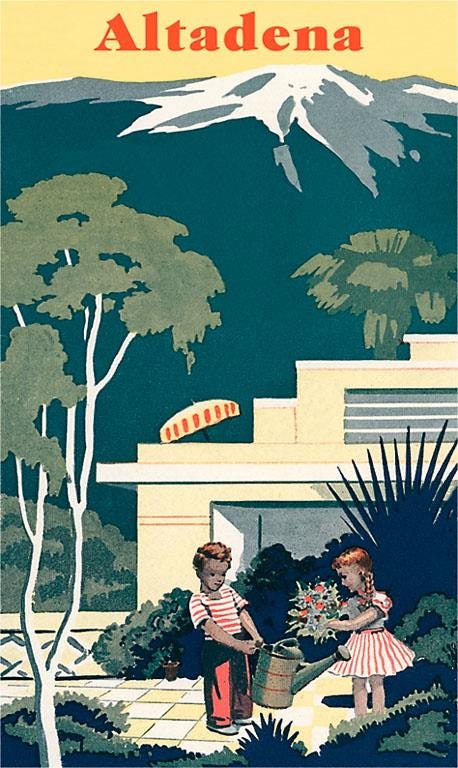
Vintage images of children in gardens are sweet enough, but this one is especially close to my heart. With “Altadena” at the top and the San Gabriel Mountains rising behind that California architecture, domestic life sits squarely in the foothill world I knew and loved. As a child I lived (twice) 5 miles away from Altadena in Sierra Madre.
The first time I lived there, we moved from the Midwest and the East Coast. We didn’t know anything about year-round sun or arid landscapes. We were enchanted by the fact that we could harvest oranges from the trees in our yard, squeeze them, and drink fresh orange juice.
This image takes me right back to digging in the dirt of our rented house, inspired by the thought that the apple seeds I was planting would sprout (they didn’t).
Images like this carry two histories at once. There’s the family history of the child with the watering can (that could have been me), the small ritual of helping, and the sweet seriousness of garden chores. All this is parallel to the larger history of Southern California domestic life, where the home garden was often treated as both beauty and virtue. In the early 20th century, gardens were seen as extensions of the household and important places to teach patience, care, order, and the careful balance between over- and under-watering.
But different emotions bubble up now when I look at Altadena after the wildfires that devastated so many homes, gardens, neighborhoods, and familiar places across the Los Angeles area. What once felt like a charming area of domestic abundance now also feels like a tribute to what people build, tend, lose, and begin again.
Altadena and its neighbor Sierra Madre have always had that mix of wildness and cultivation, tucked against the mountains but full of carefully tended homes, nearby bookstores, porches, and neighborhood rituals. It’s why this image is less like a fantasy and more like a local memory.